
Getting paid
What to Do When a Client Won't Pay: 7 Steps for Freelancers
Seven steps for freelancers when a client won't pay, from a polite reminder to a demand letter, freelancer protection laws and small claims court.

Edited by Ali Hassan, founder of Didote.
Unpaid invoices are a familiar problem in freelance work. The Freelancers Union reports that one in three freelancers has dealt with nonpayment. In twelve months, more than 1,000 freelancers from 44 US states self-reported over $7.4 million in unpaid wages to the union's "World's Longest Invoice" campaign (Freelancers Union, May 2025).
Many unpaid invoices can be resolved without a lawyer. What they need is a clear process that starts friendly and escalates only when it has to. The seven steps below take you from checking your own paperwork to a formal demand letter, freelancer protection laws and small claims court. Legal rules link to their official source, except the EU's Your Europe portal, which is cited by name. Courts and laws differ by place, so treat this as general information, not legal advice.
Key Takeaways
- Start by checking your invoice and resending it. A missing purchase order or a wrong address is easier to fix than a dispute.
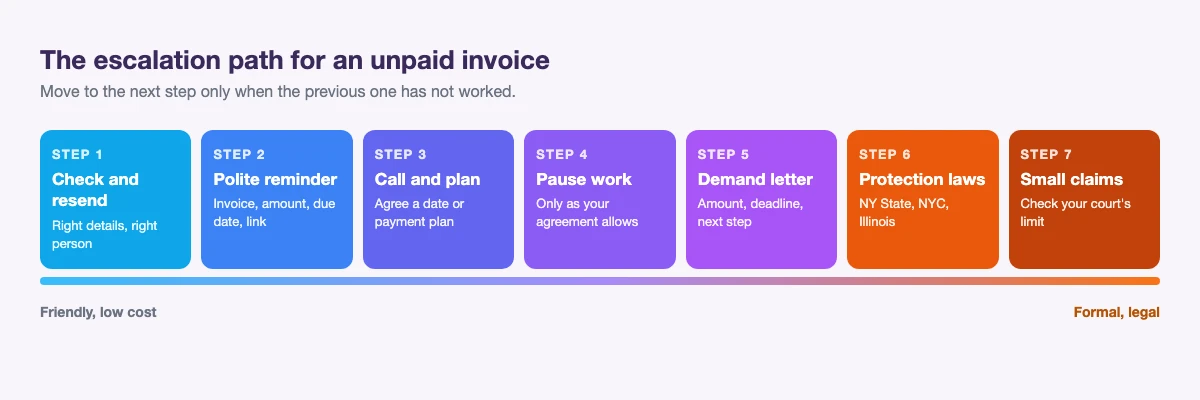
- Escalate in stages: reminder, phone call, pause on further work, formal demand letter, then a legal claim.
- In New York State, New York City and Illinois, freelancer protection laws require written contracts and payment within 30 days when no date is agreed. In New York State, a freelancer who wins a payment claim can be awarded double damages.
- Small claims courts are designed for claims without a lawyer. Limits vary widely, from $3,000 in New York town and village courts to $20,000 in Texas and CA$50,000 in Ontario.
In this guide: gather your evidence; (1) check and resend the invoice; (2) send a polite reminder; (3) call and offer a payment plan; (4) pause further work; (5) send a formal demand letter; (6) use freelancer protection laws; (7) file a small claims court claim; how to prevent it next time.
Before You Start: Gather Your Evidence
Every later step is easier if your records are in one place. Collect these before you contact the client again:
- The agreement or proposal the client accepted, including payment terms and due dates.
- Every invoice you sent, with invoice numbers and dates.
- Proof of delivery, such as file handoff emails, approval messages or a shared link history.
- All correspondence about the project and the payment.
Time: about 30 minutes. If you have no written agreement, emails confirming the scope and price still count as evidence.
Step 1: Check the Invoice and Resend It
Rule out a simple problem before assuming the client is avoiding you. An invoice can stall because of missing details rather than unwillingness to pay.
- Check the invoice against the agreement: amounts, dates, the client's legal name and any purchase order number.
- Confirm it went to the person who actually pays invoices, often an accounts team rather than your project contact.
- Resend it with a short note, such as: "Resending invoice 2026-014, due 26 November, in case it went astray."
Check: you have confirmation that the right person has the correct invoice.
Step 2: Send a Polite Reminder
A short, friendly reminder is the cheapest step, and it keeps the relationship intact. No reliable public data measures how often reminders work. Treat this timing as editorial advice: send the first reminder a few days after the due date. Send a firmer one a week later.
Sample Reminder Email
Subject: Invoice 2026-014, due 26 November
Hi Jordan,
A quick reminder that invoice 2026-014 for the brand identity project ($2,410.00) was due on 26 November. I've attached it again, and you can pay online using the link on the invoice.
Could you let me know when payment is scheduled? Thanks again for a great project.
Best, Sam
Keep the tone neutral and specific. Name the invoice, the amount, the due date and the way to pay.
Check: your reminder names the invoice, amount, due date and payment method.
Step 3: Call and Offer a Payment Plan
If written reminders get no reply, pick up the phone. A call often surfaces the real reason for the delay, such as a cash-flow problem, an internal approval or a disagreement about the work.
- Ask directly when the invoice will be paid and who is responsible.
- If the client is short of cash, offer a payment plan with dates and amounts, and confirm it by email straight after the call.
- If the client disputes the work, ask what specifically is wrong and refer back to the agreed scope.
Check: you end the call with a date, a name and a written follow-up.
Step 4: Pause Further Work
Continuing to work for a client who is not paying increases the amount at risk. Pausing is reasonable leverage, as long as your agreement allows it.
- Check your agreement for clauses on late payment, suspension of work and when ownership or usage rights pass to the client.
- If ownership transfers only on full payment, you can tell the client that final files or the license will follow once the invoice is settled.
- Put the pause in writing, politely, with the amount owed and the date work will resume after payment.
Do not delete or withhold anything your agreement says the client already owns. If you are unsure, get advice before acting.
Check: your pause is in writing and matches what your agreement allows.
Step 5: Send a Formal Demand Letter
A demand letter, sometimes called a letter before action, is a formal written request for payment. It sets a deadline and states what you will do next.
In England and Wales, the courts expect one. The Practice Direction on Pre-Action Conduct says to send "concise details of the claim," including how the amount is calculated. A defendant should reply within "14 days in a straightforward case" (Ministry of Justice, Practice Direction: Pre-Action Conduct). The same guidance asks both sides to consider other ways of settling the dispute and warns that ignoring these steps can lead to sanctions on costs or interest.
Sample Demand Letter Outline
- Your details and the client's, with the date.
- The invoice number, amount, original due date and a one-line description of the work delivered.
- Any interest or compensation you are claiming, and the rule or contract clause it is based on.
- A deadline for payment, such as 14 days, and how to pay.
- What happens next if they do not pay, for example a small claims court claim.
Send it by email and by a tracked method, and keep a copy.
Your letter can also claim late-payment charges where the law allows them. In the UK, you can claim statutory interest on late business-to-business payments at 8% plus the Bank of England base rate. You can also claim fixed compensation of £40, £70 or £100 depending on the size of the debt (GOV.UK, Late commercial payments). In the EU, creditors can claim a flat-rate €40 fee for recovery costs on each late invoice, along with statutory interest (European Commission, Late payment).
Check: the letter states the amount, the basis for any extra charges, a deadline and your next step.
Step 6: Use Freelancer Protection Laws Where They Apply
Some US jurisdictions now give freelancers specific rights when a client does not pay. If your contract is covered, you can file a complaint with a state or city agency instead of starting with a court claim.
| Law | Who it covers | Payment rule when no date is agreed | Where to complain |
|---|---|---|---|
| New York State Freelance Isn't Free Act | Contracts of $800 or more, alone or combined with others between the same parties over 120 days (GBS §1410) | No later than 30 days after the work is completed (GBS §1411) | New York State Attorney General (NYS DOL) |
| New York City Freelance Isn't Free Act | Contracts worth $800 or more, including those totaling $800 over 120 days | Within 30 days after you complete the work | NYC Department of Consumer and Worker Protection (DCWP) |
| Illinois Freelance Worker Protection Act | Contracts taking effect after July 1, 2024, for work of $500 or more over 120 days | Within 30 days of completing the services | Illinois Department of Labor (IDOL) |
These laws have real teeth. Under New York State law, a freelancer who wins a payment claim can recover damages, attorneys' fees and costs, plus double damages (GBS §1414). New York City's agency says that since 2017 it has received 4,832 freelance complaints and recovered more than $3.5 million for freelancers (NYC DCWP, February 2026).
Check: you know whether a freelancer protection law covers your contract, and you have filed a complaint if it does.
Step 7: File a Small Claims Court Claim
Small claims courts are designed for people without lawyers. Each court sets its own limit, so check that your invoice falls under the limit where the client is based, or ask the court where you can file:
| Where | Small claims limit | Official source |
|---|---|---|
| California | $12,500 for individuals; $6,250 for businesses | California Courts |
| New York City | $10,000 | NYS DOL |
| Other New York State city courts; Town and Village Courts | $5,000; $3,000 | NYS DOL |
| Texas | $20,000 | Texas State Law Library |
| England and Wales | £10,000 (small claims track) | Civil Procedure Rules, Part 26 |
| EU, cross-border | €5,000, excluding expenses; not Denmark (European Small Claims Procedure) | EU Your Europe portal |
| Ontario | CA$50,000, excluding interest and costs | Ontario.ca |
| British Columbia | CA$5,000 at the Civil Resolution Tribunal; up to CA$35,000 in Small Claims Court | Civil Resolution Tribunal; gov.bc.ca |
Fees are set by each court. In California, the filing fee is $30 to $100 (California Courts). In England and Wales, the court fee is £70 for a claim over £500 and up to £1,000, and £205 for a claim over £3,000 and up to £5,000 (GOV.UK, Make a court claim for money). The UK limits and fees in this section apply to England and Wales. Scotland and Northern Ireland run their own small claims procedures, so check with the court service there.
For cross-border claims within the EU, the European Small Claims Procedure covers amounts up to €5,000 and does not require a lawyer. The EU's Your Europe portal explains the forms and steps.
- Check the limit and filing rules for the court you plan to use.
- File online where possible, and attach your agreement, invoices, delivery proof and demand letter.
- Prepare a short timeline of events for the hearing.
If the Client Is in Another State or Country
Which court can hear your claim depends on where you and the client are based and on what your agreement says. Before filing:
- Check your agreement for a governing law or jurisdiction clause, which may name the courts that handle disputes.
- Ask the court you plan to use whether it can hear a claim against a client based elsewhere, and how the claim would be served.
- Within the EU, use the European Small Claims Procedure described above for cross-border claims up to €5,000.
- For larger or more complex cross-border claims, get local legal advice before filing, because enforcing a judgment in another country can take extra steps.
Check: your claim is filed in the right court, within its limit, with your evidence attached.
How to Prevent It Next Time
Most of what makes an unpaid invoice hard to recover is set before the work starts. These practices are editorial advice rather than legal requirements, except where noted:
- Use a written agreement every time. In New York State, New York City and Illinois, covered contracts must be in writing.
- Take a deposit before starting larger projects, and bill by milestone rather than all at the end.
- State payment terms, late-payment charges, when rights transfer and which law and courts apply in the agreement, so your demand letter can point to them.
- Invoice on delivery with a clear due date and an online payment option.
Frequently Asked Questions
Can I charge interest on a late payment?
It depends on where you work and what your agreement says. In the UK, businesses can claim statutory interest on late business-to-business payments at 8% plus the Bank of England base rate (GOV.UK). In the EU, statutory interest and a €40 flat-rate fee apply to late business payments (European Commission). Elsewhere, put any late fee or interest in your signed agreement before relying on it.
Should I use a collection agency?
It is an option for larger debts, but compare the costs carefully. We could not find independent, verifiable data on typical collection agency fees, only figures published by agencies themselves. Ask for the fee in writing, and check whether a freelancer protection law or small claims court would recover more of the money.
How long do I have to make a claim?
Time limits vary by place and type of claim. Under New York State's Freelance Isn't Free Act, claims for payment violations can be brought within six years (GBS §1414). Elsewhere, check the limitation period with your local court or an adviser, and act sooner rather than later, because evidence and the client's ability to pay both weaken over time.
The Escalation Path in Brief
An unpaid invoice is stressful, but it does not always need to go to court. Check your paperwork, remind and call, pause further work, send a formal demand letter, then use freelancer protection laws or small claims court where they apply.
The best protection is set up before the work starts. If you are an independent designer or creative freelancer, Didote drafts plain-English agreements, client emails and invoices in one workspace, so payment terms are in writing from day one.
Keep Reading
- How to Write a Freelance Invoice (Free Template + Rules)
- How to Stop Scope Creep Without Losing the Client
didote is free to start; the plans and what each AI action costs are on the pricing page. If you're choosing between tools, here is how didote compares with HoneyBook, Bonsai and Dubsado.
About This Article
This article was researched and written by the Didote team, with AI assistance for research and drafting, and edited by Ali Hassan, founder of Didote. Every statistic and quoted legal rule was checked against the cited official or primary source on November 14, 2026, and figures that could not be verified were left out. Reminder timing, payment plans, pausing work, the cross-border tips and the prevention tips are editorial advice. This is general information, not legal advice. Didote makes software for writing agreements and invoices. Questions or corrections: hello@didote.com. Learn more at didote.com, and read our privacy notice and terms.
Sources
- Freelancers Union, "One year of the World's Longest Invoice", May 2025: freelancersunion.org
- Ministry of Justice, Practice Direction: Pre-Action Conduct and Protocols: justice.gov.uk
- Ministry of Justice, Civil Procedure Rules Part 26: justice.gov.uk
- GOV.UK, Late commercial payments and Make a court claim for money: late payments and court claims
- European Commission, Late payment: ec.europa.eu
- New York State General Business Law, Article 44-A, sections 1410, 1411 and 1414; NYS Department of Labor, Freelance Isn't Free Act and small claims information
- NYC Department of Consumer and Worker Protection, Freelance workers and February 2026 press release
- Illinois Department of Labor, Freelance Worker Protection Act
- California Courts, Small claims; Texas State Law Library, Small claims
- EU Your Europe portal, European Small Claims procedure (europa.eu/youreurope, business section), retrieved November 14, 2026
- Ontario, Guide to Small Claims Court: making a claim; British Columbia, Civil Resolution Tribunal and What is Small Claims Court