
Protecting your work
How to Stop Scope Creep Without Losing the Client
Seven steps for designers and small studios to stop scope creep: write scope clearly, agree a change process, and turn extra requests into paid changes.

Edited by Ali Hassan, founder of Didote.
Scope creep happens when a project quietly grows beyond what was agreed. The UK government's project delivery guidance describes it as what happens when "unmanaged changes" mean "extra requirements are added in an uncontrolled way" (UK Government Project Delivery, The Teal Book, Change control). The Association for Project Management's glossary puts it more simply: "the continual extension of the scope of some projects" (APM). It is common. In its Pulse of the Profession 2018 survey, fielded in October 2017 with more than 4,000 project professionals, the Project Management Institute found that 52% of projects experienced scope creep (PMI, via Business Wire, February 2018).
Freelancers feel it directly. In iHire's 2026 survey of 2,250 US workers, freelancers named unclear expectations or project scope as their top client problem, at 36.1% (iHire, via SelfEmployed.com). The fix is not to refuse every request. It is to make scope visible and give every change a clear path: add it, swap it or schedule it, at an agreed price. The seven steps below show how, with sample wording and a change order template.
Key Takeaways
- Scope creep is uncontrolled change, not change itself. Changes are fine when they go through an agreed process.
- Write deliverables, revision rounds and exclusions into your agreement so you have something to point to.
- Agree a simple change process up front: the client asks, you assess, and the change is approved, rejected or deferred in writing.
- Offer options instead of a flat no: add the request at a price, swap it for something in scope, or schedule it as a later phase.
- Industry practice supports billing client-driven changes. The Graphic Artists Guild's code says they should be "an additional and separate charge."
In this guide: before you start; what counts as scope creep; (1) write the scope; (2) agree a change process; (3) spot change requests; (4) acknowledge, then name the change; (5) offer three options; (6) price the change in writing; (7) review scope at milestones; common mistakes; FAQ.
Before You Start
Have these ready before you apply the steps below:
- Your current agreement or proposal, including the deliverables and revision rounds the client accepted.
- Your hourly rate or standard fees, so you can price changes quickly.
- A place to log changes, such as a simple document or your project tool.
Time: about an hour to set up the scope wording and change process once, then a few minutes per change request. Difficulty: beginner.
What Counts as Scope Creep, and What Doesn't
A useful test comes from the Graphic Artists Guild's Code of Fair Practice. Changes or additions "not due to the fault of the artist" should be billed to the buyer "as an additional and separate charge." By contrast, there should be no charge for revisions "made necessary by errors on the part of the artist" (Graphic Artists Guild, Code of Fair Practice). In other words, fixing your own mistakes is part of the job, while new requests from the client are changes.
| Request during a branding project | In scope or a change? |
|---|---|
| Correcting a typo you introduced in the brand guide | In scope: your error |
| A second revision round when two rounds were agreed | In scope |
| A fourth revision round when three were agreed | Change |
| "Can you also design the business cards?" | Change, unless they were listed as a deliverable |
| A new creative direction after concepts were approved | Change |
Step 1: Write the Scope So You Can Point to It
You cannot manage scope that was never written down. Before work starts, the agreement or proposal should list:
- Every deliverable and its format, such as "primary logo and two lockups in SVG, PNG and PDF."
- The number of revision rounds included at each stage, and what happens after them.
- What is out of scope, such as copywriting, photography, printing or extra page templates.
- The client's responsibilities, such as providing content or feedback within an agreed number of days.
The Graphic Artists Guild's sample letter of agreement builds this in with a clause stating that additional fees will be charged for revisions made after a set number of sketches, and for revisions reflecting a new direction. Its commentary notes that the clause "requires the client to provide solid direction or to at least compensate the artist" (Graphic Artists Guild, The Letter of Agreement).
Check: someone outside the project could read your scope and tell whether a given request is included.
Step 2: Agree a Change Process Before Work Starts
A change fee is easier to discuss when the client agreed to the process at the start. The UK government's change control guidance describes a cycle of "identifying, assessing, planning, making a decision on, implementing, and closing changes." Each change is decided by choosing to "approve, reject or defer" it, so that "only beneficial or necessary changes to a baseline are implemented" (UK Government Project Delivery, The Teal Book).
For a freelance project, that cycle can be simple:
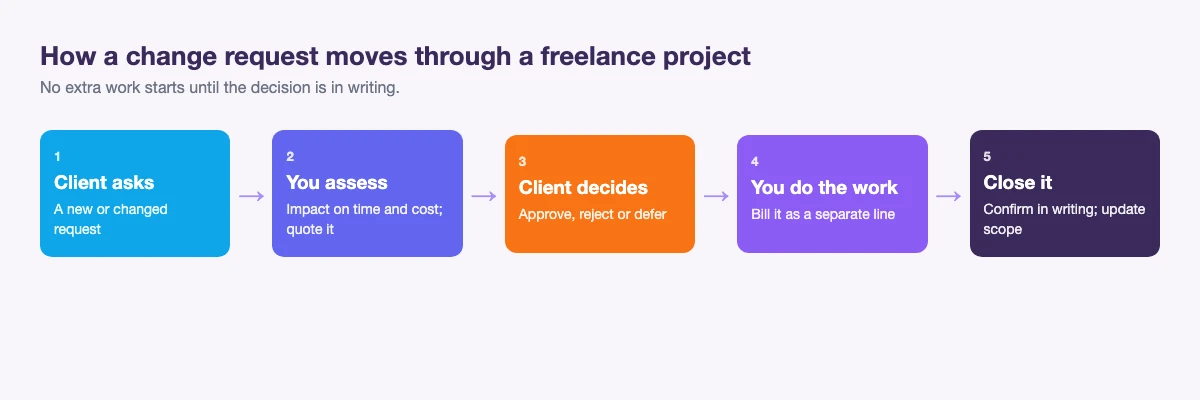
Add one sentence to your agreement: "Changes to the agreed scope will be quoted in writing and start once approved."
Check: the client has seen and agreed to how changes will be handled.
Step 3: Spot Change Requests Early
Scope creep does not always announce itself. These phrases are worth noticing, because they can introduce new work:
- "Can you just…"
- "While you're at it…"
- "It should only take five minutes."
- "We've had a new idea."
- "My boss would also like to see…"
Not every one of these is a change. Compare the request against your written scope from Step 1 before you reply.
Check: you compare every new request against the scope before you start work on it.
Step 4: Acknowledge First, Then Name It as a Change
How you respond matters as much as what you charge. Start by showing you understand why the client wants it, then say clearly that it falls outside the current scope. PMI's 2023 report found less scope creep at organizations that invest in "power skills" such as communication: 28% of their projects, compared with 40% at the organizations that prioritize them least (PMI Pulse of the Profession 2023, via AHRI, February 2023). That is a correlation across the organizations PMI surveyed, not proof for freelancers, but clear communication is the core of this step.
Sample Wording
That's a great idea, and I can see how business cards would help the launch. They're not part of the current brand identity scope, so I'll treat this as a change. I'll send you a short quote with the cost and timing today, and you can decide whether to add it now or later.
Check: your reply is friendly, names the request as a change and says what happens next.
Step 5: Offer Three Options
A flat "no" can feel like a refusal to help. Options keep the client in control while protecting your time. These three cover a wide range of requests. Add and Swap are both approved changes, one with a new price and one with a trade-off, while Schedule is a deferral:
- Add it: do the extra work for an agreed fee and timeline.
- Swap it: replace something still in scope with the new request, at no extra cost.
- Schedule it: park the request for a later phase or a follow-up project.
Present the options together and let the client choose. Each one is a "yes" to the client's goal, with a clear cost.
Check: the client has a choice, and every option has a defined cost or trade-off.
Step 6: Price the Change in Writing
Every approved change needs a price and a written record before you start, even when it is small.
Setting the price (editorial advice): base it on the same rate you used for the original quote. Estimate the extra hours at your hourly rate, or use a fixed fee for common changes such as an extra revision round. Put the price of extra rounds in your original agreement, so a change order only has to confirm it. Include any effect on the timeline, because delay has a cost for the client too.
Recording it: the UK guidance notes that a change request "is usually captured on a form which records the information needed for the change control register." For a freelancer, a short change order does the same job.
Change Order Template
| Field | Example |
|---|---|
| Change number | CO-02 |
| Project | Brand identity, Client Company Ltd |
| Requested by and date | Jordan Lee, 14 November 2026 |
| Description of the change | Design business cards (front and back), one revision round |
| Impact on timeline | Adds 3 working days; launch files move to 2 December |
| Price | Your price for the extra work |
| Option chosen | Add / Swap / Schedule |
| Approval | Client name, date and written "Approved" reply |
Bill the approved change as its own line on the next invoice, so the original project price stays clear.
Check: no extra work starts without a written approval.
Step 7: Review Scope at Each Milestone
Scope can drift gradually, so check it on purpose. At each milestone, such as concept approval or final files, spend five minutes with the client reviewing what has been delivered, which changes were approved and what remains. Catching a misunderstanding at a milestone is cheaper than arguing about it on the final invoice.
Check: each milestone ends with a short written summary of what is done, what changed and what is next.
Common Mistakes to Avoid
Doing "small" extras for free without saying so. The client never learns where the boundary is. If you choose to do a favor, name it: "Happy to include this one at no charge."
Arguing about scope in the middle of a deliverable. Raise the change when it is requested, not when the invoice is disputed.
Leaving revision rounds undefined. "Unlimited revisions" sounds generous but gives you nothing to point to.
Charging for your own errors. Industry practice treats fixes for the designer's mistakes as part of the original fee, as the Graphic Artists Guild's code sets out.
Frequently Asked Questions
Should I ever do small extras for free?
You can, as long as it is a deliberate choice. Tell the client that it is outside scope and that you are including it this time. That keeps goodwill without setting an expectation for future requests.
What if the client says the work was always included?
Go back to the written scope and walk through it together. If the agreement is genuinely unclear, consider splitting the difference this time and tightening the wording for the rest of the project. This is why Step 1 matters most.
How many revision rounds should I include?
There is no standard number, and we could not find reliable data on what is typical. The Graphic Artists Guild's sample agreement leaves the number for you to set. What matters is that the number is written down, along with the price of extra rounds. The Guild's glossary describes alterations requested after artwork is accepted as charged over the original amount (Graphic Artists Guild, Contract Glossary).
Keep the Scope, Keep the Client
Scope creep is a process problem, not a client problem. Write the scope clearly, agree how changes work, spot requests early and offer options with a price. Clients get flexibility, and you get paid for the work you actually do.
If you are an independent designer or creative freelancer, Didote drafts proposals and plain-English agreements with deliverables and revision rounds written in, so your scope is clear from the first email.
Keep Reading
- How Many Revision Rounds Should a Designer Include?
- How to Write a Freelance Design Proposal That Wins
didote is free to start; the plans and what each AI action costs are on the pricing page. If you're choosing between tools, here is how didote compares with HoneyBook, Bonsai and Dubsado.
About This Article
This article was researched and written by the Didote team, with AI assistance for research and drafting, and edited by Ali Hassan, founder of Didote. Every statistic and quoted guideline was checked against the cited source on November 14, 2026, and figures that could not be verified were left out. The trigger phrases, sample wording, three-option approach, pricing guidance, milestone reviews and FAQ answers are editorial advice, not research findings. No published data measures whether change processes affect client retention. Didote makes software for writing proposals and agreements. Questions or corrections: hello@didote.com. Learn more at didote.com, and read our privacy notice and terms.
Sources
- UK Government Project Delivery, The Teal Book, Part E, Chapter 22: Change control (modified July 2026): projectdelivery.gov.uk
- Association for Project Management, "What is scope creep and how can we mitigate it?", October 2022: apm.org.uk
- Project Management Institute, Pulse of the Profession 2018 press release, February 2018: businesswirechina.com
- PMI Pulse of the Profession 2023, as reported by AHRI, February 2023: ahri.com.au
- iHire, The Freelance Revolution (2026), as reported by SelfEmployed.com: selfemployed.com
- Graphic Artists Guild: Code of Fair Practice, The Letter of Agreement and Contract Glossary