
Protecting your work
How Many Revision Rounds Should a Designer Include?
There is no standard number of design revision rounds. Here is how to choose yours, word it in your agreement and price extra rounds fairly.

Edited by Ali Hassan, founder of Didote.
Short answer: there is no industry-standard number of revision rounds, and we could not find a reliable survey that measures what designers typically include. What matters is that you choose a number, write it into your agreement and state what extra rounds cost. The Graphic Artists Guild's Letter of Agreement, a model contract for designers, leaves the number for you to fill in. Its clause reads "Additional fees will be charged for revisions made after (insert your standard here) sketches," and its commentary asks designers directly: "How many revisions are acceptable to you?" (Graphic Artists Guild, The Letter of Agreement).
Advice on choosing and pricing rounds is our editorial view, and it is labelled as such.
Key Takeaways
- No reliable data sets a standard number of design revision rounds. Choose one that fits the project, and write it down.
- Industry guidance bills client-driven changes as extra and treats fixes for the designer's own errors as part of the job.
- A revision refines the agreed direction. A new direction, or a change after final approval, is outside the included revisions and should be priced separately.
- State the number of rounds, what a round includes and the price of each extra round in your agreement.
In this guide: what counts as a revision; do drafts count; who pays for which changes; how to choose your number; rounds by stage; how Fiverr handles revisions; sample clause; pricing extra rounds; feedback deadlines; common problems.
Revision Basics
What counts as a revision?
A revision is a change that refines work within the agreed scope and direction, such as adjusting colors, spacing or type on an approved concept. It is different from a new direction, where the client asks for a different idea altogether. The Graphic Artists Guild's Letter of Agreement charges extra both for revisions beyond the agreed number and for revisions reflecting a new direction to the assignment (Graphic Artists Guild, The Letter of Agreement).
A revision also differs from an alteration made after approval. In print production, these are called author's alterations, which a 1998 University of Houston trade article defines as "adjustments made by the customer after the copy and artwork have been received by the printer" (Blakley and Waite, University of Houston).
Do drafts or previews count as revisions?
Not necessarily, and it is worth saying so in your agreement. Fiverr's rules, for example, state that "Drafts are not considered revisions" (Fiverr Help Center, order process). Editorial advice: if you share work-in-progress previews, say in your agreement that they are for information and do not use up a revision round unless the client sends consolidated feedback on them.
Who pays for which changes?
The Graphic Artists Guild's Code of Fair Practice sets out who pays. Changes "not due to the fault of the artist" should be billed to the buyer "as an additional and separate charge." There should be no charge for revisions "made necessary by errors on the part of the artist" (Graphic Artists Guild, Code of Fair Practice). The Code of Fair Practice also says "Alterations shall not be made without consulting the artist."
| Type of change | Who pays | Basis |
|---|---|---|
| Fixing a mistake the designer made | Designer (no charge) | Guild Code of Fair Practice, Art. 4 |
| Revision within the agreed number of rounds | Included in the fee | Your agreement |
| Revision beyond the agreed number | Client, as an extra charge | Guild Code, Art. 3; Guild Letter of Agreement |
| New creative direction | Client, as an extra charge | Guild Letter of Agreement |
| Change after final approval | Client, as an extra charge | Guild Contract Glossary |
For changes after final approval, the Guild's Contract Glossary states: "After acceptance of artwork, if alterations are required, a payment is charged over the original amount" (Graphic Artists Guild, Contract Glossary).
Choosing Your Number
How do I decide how many rounds to include?
Editorial advice: match the number of rounds to how well defined the project is and how many people will give feedback. Fewer rounds suit tightly defined work with one decision-maker. More rounds suit exploratory work or projects with several stakeholders. These ranges are a starting point for your own pricing, not an industry norm:
| Project type | Starting point to consider | Why |
|---|---|---|
| Small, well-defined task (social graphic, resize, simple flyer) | 1 round | Brief is specific; changes should be minor |
| Logo or identity concept | 2 rounds per stage | Concepts and refinement need separate feedback |
| Multi-page or multi-stakeholder project (brand system, website design) | 2–3 rounds per stage, plus one consolidated feedback rule | More reviewers mean more input to reconcile |
Whatever number you pick, price your base fee to cover it. If you include more rounds, your fee should reflect the extra time.
Should revision rounds differ by project stage?
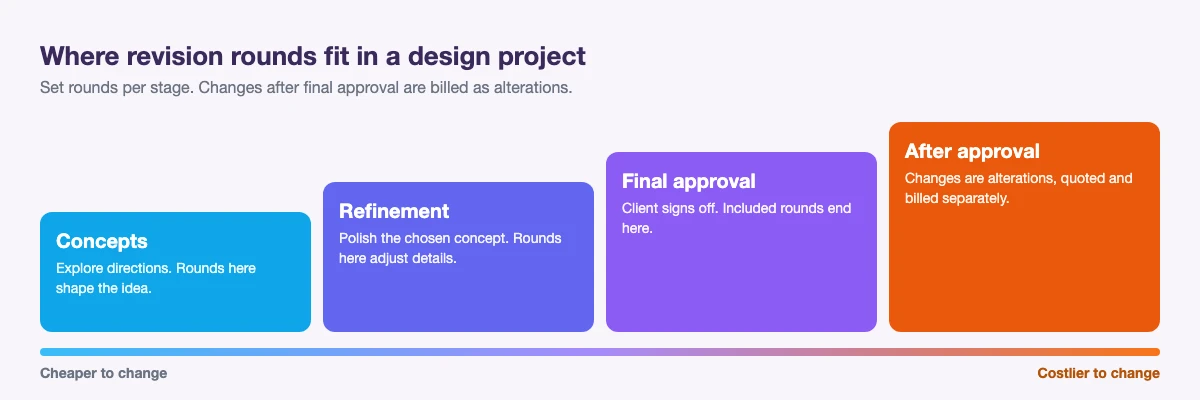
Editorial advice: it can help. One structure is to set rounds separately for concepts and for refinement, so feedback on early ideas does not eat into the rounds needed to finish the chosen design. The Guild's Letter of Agreement ties its revision limit to "sketches," the early stage of a project (Graphic Artists Guild).
Later changes are more expensive to make. A 1998 University of Houston trade article on print production notes that "Changes are more costly if they are requested after the proofing stage of the job" (University of Houston).
Book publishers limit late changes for a similar reason. UBC Press tells authors that, at the page-proof stage, "rewriting and stylistic revision should not be undertaken" and that late changes are charged back (UBC Press). The University of Minnesota Press says of alterations to proofs that "Changes to wording or style are not allowed at this stage" (University of Minnesota Press).
How does Fiverr handle revisions?
Fiverr, a freelance marketplace, lets sellers set the number themselves, which is consistent with there being no fixed standard. Sellers set "a revision count" for each package. The platform states that "Fiverr requires you to offer at least one revision option per package" (Fiverr Help Center, Creating a Gig). Fiverr also says "Drafts are not considered revisions." The client "has three days to accept the delivery, request revisions, or request an extension to the review period" (Fiverr Help Center, order process). These are platform rules as of November 2026 and can change.
Wording and Pricing
What should a revision clause say?
A clear clause states the number of rounds, what one round includes and what happens after. Here is a sample you can adapt. It is editorial advice, not legal advice:
Revisions. The fee includes two (2) rounds of revisions at the concept stage and two (2) rounds at the refinement stage. A round means one set of consolidated written feedback from the Client, followed by one updated version from the Designer. Additional rounds, changes that reflect a new creative direction, and changes requested after final approval will be quoted and billed separately at the Designer's stated rate. Corrections of errors made by the Designer are not counted as revisions.
The Guild's Contract Glossary also suggests narrowing what post-approval "alterations" means, for example to "cropping and sizing only" (Graphic Artists Guild, Contract Glossary).
How should I price extra rounds?
Editorial advice: use either a fixed fee per extra round or your hourly rate, and put that price in the original agreement, so you never have to negotiate it mid-project. A fixed fee is easier for clients to approve. Hourly billing is fairer when the size of a round varies a lot. Either way, confirm each extra round in writing before you start it.
Illustrative example (hypothetical figures): a designer quotes a logo project with two concept rounds and two refinement rounds included. The agreement sets each extra round at a fixed fee equal to about three hours at the designer's hourly rate. When the client asks for a fifth round, the designer sends a one-line change note with that fee, and starts once the client replies "Approved."
Should revision rounds have a feedback deadline?
Editorial advice: yes. Without a deadline, a project can stall while you wait for feedback. State how many working days the client has to send consolidated feedback for each round, and what happens if none arrives, for example that the latest version is treated as approved. Marketplaces build in similar windows. On Fiverr, "The client has three days to accept the delivery, request revisions, or request an extension to the review period" (Fiverr Help Center, order process).
Common Problems
What if a client asks for unlimited revisions?
Editorial advice: offer a defined number with a clear price for more. You can also offer a higher-priced package that includes more rounds. Unlimited revisions leave no boundary to point to when feedback continues indefinitely.
What if feedback arrives in pieces from several people?
Editorial advice: define a round in your agreement as one set of consolidated written feedback from the client, followed by one updated version from you. Ask the client to name one person who collects and sends feedback. Feedback sent separately by different people then counts as separate rounds, unless that named contact combines it into one message.
What if "revisions" turn into a new direction?
Editorial advice: say so as soon as you notice it, and refer to the agreement. A new direction is not a revision, and the Graphic Artists Guild's Letter of Agreement treats it as a separate charge. Offer the client a quote for the new direction, or the option to continue refining the approved concept.
Make Your Number Visible
The right number of revision rounds is the one you have written down and priced. Choose rounds per stage, define what a round includes, bill client-driven changes and new directions separately, and correct your own errors without charge.
If you are an independent designer or creative freelancer, Didote drafts proposals and plain-English agreements with a revisions policy written in, so clients see the terms before the work starts.
Still Have Questions?
If your situation is not covered here, email us at hello@didote.com and we will consider it for a future update.
Keep Reading
- How to Stop Scope Creep Without Losing the Client
- How to Write a Freelance Design Proposal That Wins
didote is free to start; the plans and what each AI action costs are on the pricing page. If you're choosing between tools, here is how didote compares with HoneyBook, Bonsai and Dubsado.
About This Article
This article was researched and written by the Didote team, with AI assistance for research and drafting, and edited by Ali Hassan, founder of Didote. Every quoted guideline and platform rule was checked against the cited source on November 14, 2026. We found no reliable survey of how many revision rounds designers include, so the article gives none. The project-type ranges, rounds-by-stage structure, sample clause, pricing approach and example, feedback deadlines, draft handling and answers to common problems are editorial advice, not research findings or legal advice. Didote makes software for writing proposals and agreements. Questions or corrections: hello@didote.com. Learn more at didote.com, and read our privacy notice and terms.
Sources
- Graphic Artists Guild: The Letter of Agreement, Code of Fair Practice and Contract Glossary
- Kelly Blakley and Jerry Waite, "Authors Alterations: Recovering Your Costs", University of Houston College of Technology: uh.edu
- UBC Press, Overview of the Production Process: ubcpress.ca
- University of Minnesota Press, Manuscript Preparation Guide, section 7.16: manifold.umn.edu
- Fiverr Help Center, Creating a Gig and A freelancer's guide to the Fiverr order process, retrieved November 14, 2026