
Getting paid
How to Write a Freelance Invoice (Free Template + Rules)
A free freelance invoice template plus eight steps covering what UK, EU, US and Canadian guidance says and the details that help clients pay on time.

Edited by Ali Hassan, founder of Didote.
A freelance invoice has one job: getting you paid, on time, without a follow-up email. Many invoices fail at it. Bonsai's analysis of three years of invoices from its freelance users found that 29% were paid at least a day late (Bonsai, January 2026). Xero reports that US small businesses waited an average of 29.3 days to be paid in the June quarter of 2026, with payments arriving 8.5 days late on average (Xero US, Invoice payment times, August 2026).
A clear invoice will not fix a client who does not want to pay. It does remove the easy excuses: a missing due date, a vague description or no simple way to pay. Below is a free template you can copy, followed by eight steps that explain each part, including what official guidance in the UK, EU, US and Canada says an invoice should contain.
Key Takeaways
- UK guidance requires your details, the client's details, a unique invoice number, the invoice date, the supply date, a description of the work and the amounts. We also recommend a due date on every invoice.
- UK and EU VAT rules require sequential, unique invoice numbers. A simple scheme such as 2026-014 works.
- Put payment terms and the due date on the invoice itself. In the UK, a business-to-business (B2B) invoice with no agreed date is late 30 days after the client receives it, or after delivery if that is later.
- Two invoicing vendors, Xero and Zeller, report faster payment when clients can pay online. This is vendor data, not independently verified.
- This guide is general information, not legal or tax advice. Check the rules where you and your client are based.
Free Freelance Invoice Template
Here is what the finished invoice looks like with sample values:
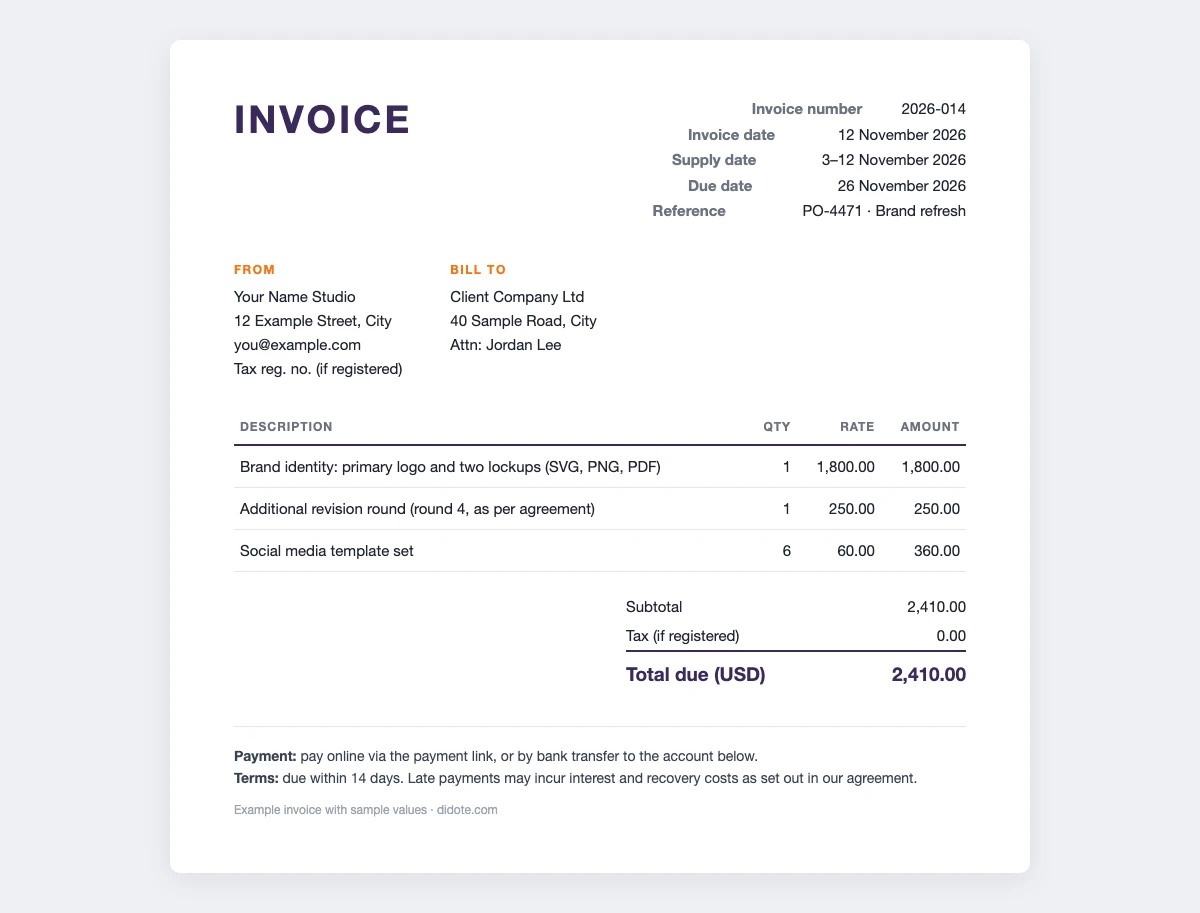
To build your own, copy the three blocks below into your document editor, spreadsheet or invoicing tool and replace the example values. Each field is explained in the steps that follow.
Header Fields
| Field | Example |
|---|---|
| Invoice number | 2026-014 |
| Invoice date | 12 November 2026 |
| Supply date | 3–12 November 2026 |
| Due date | 26 November 2026 (14 days) |
| From | Your name or business name, address, email |
| Bill to | Client company name, address, contact name |
| Reference | Client purchase order or project name, if any |
| Tax registration number | Your VAT, GST or HST number, if registered |
Line Items
| Description | Quantity | Rate | Amount |
|---|---|---|---|
| Brand identity: primary logo and two lockups (SVG, PNG, PDF) | 1 | 1,800.00 | 1,800.00 |
| Additional revision round (round 4, as per agreement) | 1 | 250.00 | 250.00 |
| Social media template set, 6 designs | 6 | 60.00 | 360.00 |
Totals
| Summary | Amount |
|---|---|
| Subtotal | 2,410.00 |
| Tax (if registered; show rate) | 0.00 |
| Total due | 2,410.00 (state currency) |
Payment: pay online at your payment link or by bank transfer to your account details. Terms: payment due within 14 days. Late payments may incur interest and recovery costs as set out in our agreement.
Step 1: Add Your Details and the Client's
Missing or wrong details can stall an invoice in a client's accounts department.
In the UK, the government's guidance lists what an invoice must include. That covers your business name, address and contact information, and the name and address of the customer you are invoicing (GOV.UK, Invoices: what they must include). Sole traders must show their own name and any business name they use. If they trade under a business name, they must also show an address where legal documents can be delivered. Limited companies must show their full company name as it appears on the certificate of incorporation.
- Write your trading name exactly as it appears in your registration, if you have one, plus your address and email.
- Use the client's legal company name, not just the name of your contact.
- Add the client's purchase order number if they gave you one, because some accounts teams cannot process an invoice without it.
Check: the client's finance team could process the invoice without asking who you are or which project it belongs to.
Step 2: Give It a Unique Invoice Number
UK guidance requires "a unique identification number" on every invoice. For VAT invoices, both the UK and EU rules go further. They require a sequential number "based on one or more series" that uniquely identifies the invoice (GOV.UK, VAT Notice 700/21) (EU VAT Directive, Article 226). Because more than one series is allowed, a year prefix or a per-client series works, as long as each number is unique and runs in order within its series.
- Pick one scheme and keep it, for example 2026-001, 2026-002 and so on.
- As a matter of good practice, never reuse a number, even for a cancelled invoice. Issue a credit note instead, which is a document that cancels or reduces an invoice you already sent.
- If you want a series per client, add a short client code, such as ACME-2026-03.
Check: you can find any past invoice by its number in seconds.
Step 3: Date It, and Add the Supply Date
UK guidance asks for both the invoice date and the supply date, meaning the date the goods or service were provided. VAT-registered businesses in the UK normally must issue a VAT invoice within 30 days of the supply (GOV.UK, VAT Notice 700/21). For project work that spans weeks, give the period, such as "3–12 November 2026".
- Invoice on the day the work is delivered or the milestone is approved, rather than at the end of the month.
- For retainers, state the period covered, such as "Design retainer, November 2026".
Check: the invoice date and supply date are both present and make sense together.
Step 4: Describe the Work Line by Line
UK guidance requires "a clear description of what you're charging for". Canada's GST/HST rules ask for a description of each supply sufficient to identify it on invoices of C$500 or more (Justice Laws, SOR/91-45, s.3). Clear lines also help prevent disputes, because each one maps back to something the client agreed to.
- Use one line per deliverable or milestone, matching the wording in your proposal or agreement.
- For hourly work, list hours and rate, and attach or link a short timesheet.
- Bill extra revision rounds or out-of-scope requests as separate lines, and reference the clause that allows them.
Check: every line on the invoice matches a deliverable, milestone or agreed extra.
Step 5: Add Tax, If It Applies
The rules differ by country:
| Where you are | What official guidance says |
|---|---|
| UK | An invoice is legally required when both you and your customer are VAT-registered, and then it must be a VAT invoice (GOV.UK). Show the VAT amount if VAT applies. |
| EU | VAT invoices must include, among other items, the supplier's VAT number (and the customer's where applicable), the VAT rate and amount, and a "reverse charge" note where the customer, not the supplier, accounts for the VAT (Article 226). |
| US | The IRS does not prescribe an invoice format. It says you may use any recordkeeping system that clearly shows income and expenses, and lists invoices among the documents that support gross receipts (IRS). |
| Canada | Under the GST/HST input tax credit rules, invoices need more detail as the total rises. Under C$100: supplier name, date and total. From C$100: also the GST/HST registration number and the tax amount or a tax-included statement with the rate. From C$500: also the recipient's name, payment terms and a description of each supply (SOR/91-45). |
- If you are registered for VAT, GST or HST, show your registration number, the rate and the tax amount as separate lines.
- If you are not registered, the usual practice is not to add tax. You can add a short line such as "VAT not charged" to avoid questions.
- For clients in another country, check whether a reverse-charge note applies, and ask an accountant if you are unsure.
Check: the tax line, rate and registration number match your actual registration status.
Step 6: Set Payment Terms and a Due Date
Put a specific due date on every invoice, and know the default rules that apply if none is agreed. In the UK and EU, defaults apply when no date is agreed, and caps apply to agreed terms:
| Rule | UK (GOV.UK) | EU (Directive 2011/7/EU, Art. 3) |
|---|---|---|
| No payment date agreed | Late 30 days after the customer receives the invoice, or after delivery if later | Due 30 calendar days after the invoice is received |
| Longest agreed B2B term | Usually within 60 days; longer only if fair to both businesses | No more than 60 calendar days unless expressly agreed |
This step and Step 8 cover UK and EU statutory rules only. The sources used here set no equivalent federal defaults for the US or Canada, so check local rules there.
- Write an actual date, such as "Due 26 November 2026", not just "Net 14".
- Agree terms in your contract before the work starts, so the invoice simply repeats them.
- Choose terms your clients can realistically meet.
Check: the invoice shows a specific due date that matches your agreement.
Step 7: Make It Easy to Pay Online
Two invoicing companies report that online payment options are linked with faster payment. These figures come from each company's own customers and are not independently verified:
- Xero says businesses using its online invoice payments get paid up to twice as fast (Xero US, August 2026).
- In Zeller's Invoicing Report 2025, covering more than 100,000 invoices sent by Australian businesses, invoices payable by card were paid in an average of 2.4 days, against 14.5 days for bank-transfer-only invoices (Zeller Invoicing Report 2025).
- Add a payment link for card or online payment, and keep bank transfer details as a second option.
- State the currency clearly, especially for international clients.
- Send the invoice as a PDF or a link, not an editable document.
Check: a client could pay the invoice from their phone without emailing you.
Step 8: State Your Late-Payment Terms
In the UK, businesses can claim statutory interest on late B2B payments at 8% plus the Bank of England base rate. A rate agreed in the contract replaces the statutory rate (GOV.UK, Interest on late commercial payments). They can also claim fixed debt recovery costs (GOV.UK, Claim debt recovery costs):
| Size of the unpaid debt | Fixed compensation |
|---|---|
| Up to £999.99 | £40 |
| £1,000 to £9,999.99 | £70 |
| £10,000 or more | £100 |
In the EU, statutory interest for late B2B payments is at least 8 percentage points above the European Central Bank's reference rate, and creditors are entitled to at least €40 compensation for recovery costs (European Commission, Late payment).
- Add one short line referring to late interest and recovery costs as set out in your agreement.
- Outside the UK and EU, put any late fee or interest in your signed agreement before relying on it, and check local rules.
Check: your late-payment line matches what the client agreed to in your contract.
Common Mistakes to Avoid
Sending the invoice weeks after the work. The project is no longer top of mind for the client. Invoice on delivery or approval.
Writing "Net 30" without a date. The client has to work out the deadline, and disputes over when the clock started become possible. Write the actual due date.
Vague line items such as "Design work". These invite questions and delay approval. Match each line to an agreed deliverable.
Offering only one way to pay. Every extra step makes it easier to put the invoice aside. Add an online payment link.
Changing an invoice after sending it. It breaks your numbering and your records. Issue a credit note and a new invoice instead.
Frequently Asked Questions
Can I invoice as a sole trader under my own name?
In the UK, yes. Sole traders can invoice under their own name, as long as the invoice shows that name and any business name they use (GOV.UK). Elsewhere, check whether your country requires a tax number on invoices before you send one. If you are registered for VAT, GST or HST, your invoices must also meet the requirements in Step 5.
What is the difference between an invoice and a receipt?
An invoice asks for payment. A receipt confirms that payment has been made. UK government guidance notes that an invoice is not a receipt (GOV.UK). When the client pays, you can send a receipt or mark the invoice as paid in your invoicing tool.
Should I invoice upfront for design projects?
A deposit before starting and the balance on delivery is an arrangement many freelancers use for larger projects. If you use one, state in your agreement how much is due upfront and on what milestones, and number each invoice in the same series.
Freelance Invoice Checklist
Before you send an invoice, check that it has:
- Your name or business name, address and contact details
- The client's legal name and address, plus any purchase order number
- A unique, sequential invoice number
- The invoice date and the supply date or period
- One clear line per deliverable, with quantity, rate and amount
- Tax shown correctly, with your registration number if registered
- A specific due date and the agreed payment terms
- An online payment link and bank details
- A short line on late-payment terms from your agreement
If you are an independent designer or creative freelancer, Didote turns your tracked hours into an invoice with free PDF export, alongside your proposals and agreements. Use the template above, or let it fill in the details for you.
Keep Reading
- What to Do When a Client Won't Pay: 7 Steps for Freelancers
- Why Freelancers Need Management Tools, Not More Clients
didote is free to start; the plans and what each AI action costs are on the pricing page. If you're choosing between tools, here is how didote compares with HoneyBook, Bonsai and Dubsado.
About This Article
This article was researched and written by the Didote team, with AI assistance for research and drafting, and edited by Ali Hassan, founder of Didote. Every statistic and quoted rule was checked against the cited sources on November 14, 2026, and figures that could not be verified were left out. Practical tips, such as numbering and deposit practices, are editorial advice. This is general information, not legal or tax advice. Several sources, including Bonsai, Xero and Zeller, sell invoicing software and report data from their own customers, and Didote makes invoicing software too. Questions or corrections: hello@didote.com. Learn more at didote.com, and read our privacy notice and terms.
Sources
- GOV.UK, Invoicing and taking payment from customers: overview and what invoices must include
- GOV.UK, Record keeping for VAT (VAT Notice 700/21), updated March 2024: gov.uk
- GOV.UK, Late commercial payments: overview, interest and recovery costs
- Council Directive 2006/112/EC, Article 226: legislation.gov.uk
- Directive 2011/7/EU, Article 3: legislation.gov.uk
- European Commission, Late payment: ec.europa.eu
- IRS, What kind of records should I keep: irs.gov
- Justice Laws Canada, Input Tax Credit Information (GST/HST) Regulations, s.3: justice.gc.ca
- Bonsai, late freelance payment analysis, January 2026: hellobonsai.com
- Xero, Invoice payment times, August 2026: xero.com
- Zeller, Invoicing Report 2025: myzeller.com